
Full Mouth Rehabilitation in Bhiwadi – Restore Your Smile, Teeth and Confidence
A healthy smile is not just about having white and straight teeth. Your teeth should also work properly when you eat, speak and smile. However, problems such as multiple missing teeth, severely damaged teeth, worn-out teeth, gum disease and long-standing dental issues can affect your overall oral health.
If you have difficulty chewing food, feel pain while biting, or have several damaged or missing teeth, full mouth rehabilitation may help restore your dental health.
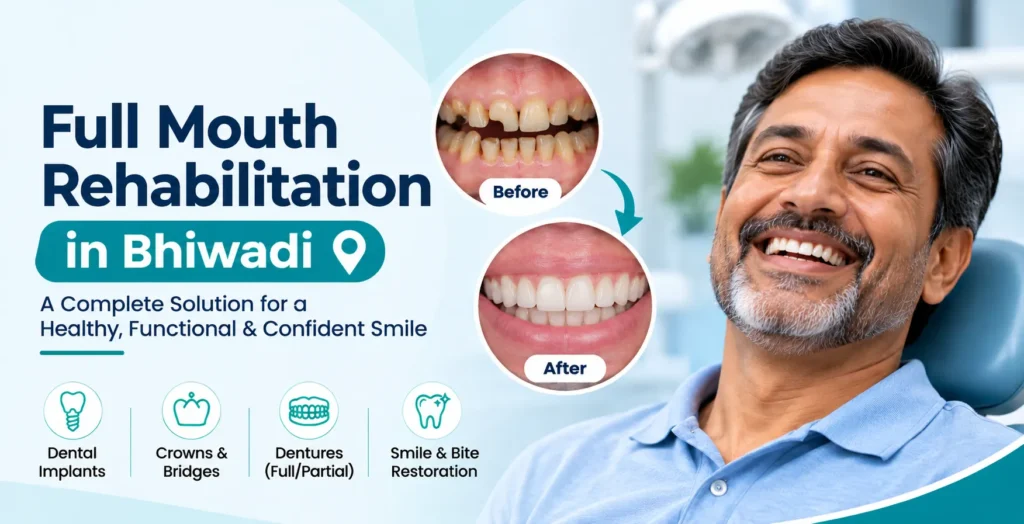
At V Care Dental and Implant Centre, we understand that every patient has different dental concerns. Some people may have lost multiple teeth due to ageing or gum problems, while others may have severely worn-out teeth because of grinding, decay or previous dental treatments.
Full mouth rehabilitation is a comprehensive dental treatment approach that focuses on restoring the appearance, strength and function of your teeth. Depending on your condition, the treatment may involve dental implants, crowns, bridges, root canal treatment, dentures and gum care.
If you are looking for full mouth rehabilitation in Bhiwadi, a detailed dental examination can help identify the right treatment plan for your needs.
What Is Full Mouth Rehabilitation?
Full mouth rehabilitation, also known as full mouth reconstruction or full mouth restoration, is a combination of dental procedures used to repair or replace multiple teeth in the upper jaw, lower jaw or both.
Unlike a single dental treatment, this approach addresses several oral health problems together.
For example, consider someone who has:
- Multiple missing teeth.
- Broken or severely damaged teeth.
- Difficulty chewing normal food.
- Worn-out teeth due to teeth grinding.
- Several teeth affected by cavities.
- Old or damaged dental crowns and bridges.
- Bite alignment problems.
- Gum-related dental issues.
In such situations, treating only one tooth may not solve the overall problem. A dentist needs to evaluate the entire mouth, including the teeth, gums, jaw joints and bite relationship.
The main goal of full mouth rehabilitation is to create a healthy, comfortable and functional bite while improving the appearance of your smile.
Who Needs Full Mouth Rehabilitation?
Not everyone with a missing or damaged tooth needs full mouth reconstruction. However, if several teeth are affected by different dental problems, a comprehensive treatment plan may be recommended.
You may benefit from full mouth rehabilitation if you experience the following conditions.
1. Multiple Missing Teeth
Losing several teeth can affect your ability to chew food properly. It may also cause nearby teeth to shift into empty spaces.
Dental implants, bridges or dentures may be considered to replace missing teeth, depending on your bone condition and oral health.
2. Severely Damaged or Broken Teeth
Teeth can become damaged due to accidents, untreated cavities, old fillings or excessive biting pressure.
When several teeth are damaged, dental crowns, root canal treatment or other restorative procedures may help save and restore them.
3. Worn-Out Teeth
Some people grind or clench their teeth, especially during sleep. This condition is called bruxism.
Over time, grinding can reduce tooth height, damage enamel and cause sensitivity or jaw discomfort.
Full mouth rehabilitation may involve restoring the worn teeth and managing the underlying grinding problem.
4. Difficulty Chewing Food
If you cannot comfortably eat foods such as roti, vegetables, fruits or nuts because of missing or damaged teeth, your chewing function may be affected..
Restoring the damaged teeth and replacing missing ones can help improve chewing ability.
5. Severe Tooth Decay
When multiple teeth have deep cavities, the damage may extend towards the dental pulp.
Depending on the condition, root canal treatment followed by crowns may help preserve some of these teeth.
6. Bite Problems
An uneven bite can put extra pressure on certain teeth. This may lead to discomfort, tooth wear, fractures or difficulty chewing.
A dentist may recommend bite correction as part of a comprehensive rehabilitation plan.
Full Mouth Rehabilitation Treatments Available in Bhiwadi
Full mouth rehabilitation is not a single procedure. It combines different dental treatments based on the patient’s condition.
At V Care Dental and Implant Centre, the treatment approach may include the following procedures, depending on clinical assessment.
Dental Implants for Missing Teeth
Dental implants are used to replace missing teeth. A small implant fixture is placed inside the jawbone to act as an artificial tooth root.
After the implant integrates with the surrounding bone, a dental crown can be attached.
Benefits of dental implants:
- Replace missing teeth with fixed teeth.
- Help maintain chewing function.
- Do not require grinding down neighbouring healthy teeth.
- Provide a natural-looking appearance.
- Help reduce bone loss associated with missing teeth.
However, implant treatment requires sufficient bone support and healthy gums. Some patients may need additional procedures, such as bone grafting.
Dental Crowns and Bridges
Dental crowns cover damaged teeth and help restore their shape, strength and function.
They may be recommended after root canal treatment or when a tooth has extensive structural damage.
Dental bridges are used to replace one or more missing teeth by supporting an artificial tooth with neighbouring teeth or implants..
Common crown materials include:
- Zirconia crowns.
- Metal-ceramic crowns.
- All-ceramic crowns.
- E-max crowns.
The right material depends on the tooth’s position, bite pressure, appearance requirements and budget.
Root Canal Treatment
When tooth decay reaches the pulp, it may cause severe pain, infection or sensitivity.
Root canal treatment removes the infected pulp, cleans the root canals and seals the inside of the tooth.
A crown may be recommended afterwards to protect the treated tooth from fracture, depending on how much natural tooth structure remains.
Full Mouth Dental Crowns
When several teeth are severely worn, broken or damaged, dental crowns may be used to restore their shape and chewing function.
The dentist first checks the condition of the teeth, gum health and bite before planning multiple crowns.
Full mouth crowns are not suitable for everyone. Healthy tooth structure should be preserved wherever possible.
Complete and Partial Dentures
Dentures are removable appliances used to replace missing teeth.
- Complete dentures: Used when all natural teeth in a jaw are missing.
- Partial dentures: Used when some natural teeth remain.
They can be a suitable option for patients who want to restore their smile and chewing ability without undergoing implant surgery.
Gum Disease Treatment
Healthy gums provide support to your teeth. If you have gum disease, bleeding gums, swelling or loose teeth, these problems should be addressed before proceeding with major restorative treatment.
Depending on the severity, treatment may include professional cleaning, deep cleaning or periodontal procedures.
Full Mouth Rehabilitation Procedure: Step-by-Step Process
Full mouth rehabilitation requires proper planning because several teeth and dental structures may be involved.
Here is how the treatment generally progresses.
Step 1: Complete Dental Examination
The first step is a detailed examination of your teeth, gums and bite.
The dentist will understand your dental history, existing problems, previous treatments and expectations.
You may also be asked about:
- Tooth pain or sensitivity.
- Difficulty chewing.
- Bleeding gums.
- Teeth grinding.
- Previous root canal treatments.
- Missing or loose teeth.
Step 2: Dental X-Rays and Scans
Dental X-rays help evaluate tooth roots, jawbone condition and hidden infections.
Depending on your case, the dentist may recommend:
- OPG (Orthopantomogram).
- Intraoral dental X-rays.
- CBCT scan for detailed implant planning.
- Digital impressions or bite assessment.
These investigations help in preparing a more accurate treatment plan.
Step 3: Personalised Treatment Planning
After examination, the dentist prepares a treatment plan according to your oral health condition.
For example:
- Missing teeth may require implants or bridges.
- Deeply infected teeth may need root canal treatment.
- Damaged teeth may require crowns.
- Gum disease may require periodontal treatment.
- Worn-out teeth may require bite rehabilitation.
The dentist should also explain the expected treatment duration, costs, benefits and possible limitations.
Step 4: Treating Existing Dental Problems
Before placing permanent restorations, existing infections and gum problems need attention.
This stage may include cleaning, root canal treatment, removal of non-restorable teeth and other necessary procedures.
Step 5: Replacing Missing or Damaged Teeth
Depending on your treatment plan, dental implants, crowns, bridges or dentures may be provided.
Temporary restorations may also be used while the final treatment is being completed.
Step 6: Final Bite Adjustment and Smile Restoration
The final stage involves checking the bite, tooth contact, comfort and appearance.
The dentist ensures that the restored teeth work comfortably together.
Follow-up visits may be required to monitor healing and make adjustments.
Benefits of Full Mouth Rehabilitation
Full mouth rehabilitation can improve several aspects of oral health when properly planned and performed.
1. Improved Chewing Ability
Replacing missing teeth and restoring damaged teeth can help you chew food more comfortably.
2. Better Smile Appearance
Dental crowns, bridges and implants can improve the appearance of damaged or missing teeth.
3. Restoration of Tooth Function
Reconstructing damaged teeth helps restore their shape, strength and ability to perform daily functions.
4. Improved Bite Balance
Properly planned restorations can help distribute biting pressure more evenly across the teeth.
5. Better Oral Health Management
A comprehensive treatment plan helps address multiple dental concerns instead of treating each problem separately without considering the overall bite.
6. Improved Confidence
Restoring missing or damaged teeth may make you feel more comfortable while smiling, speaking and interacting with others.
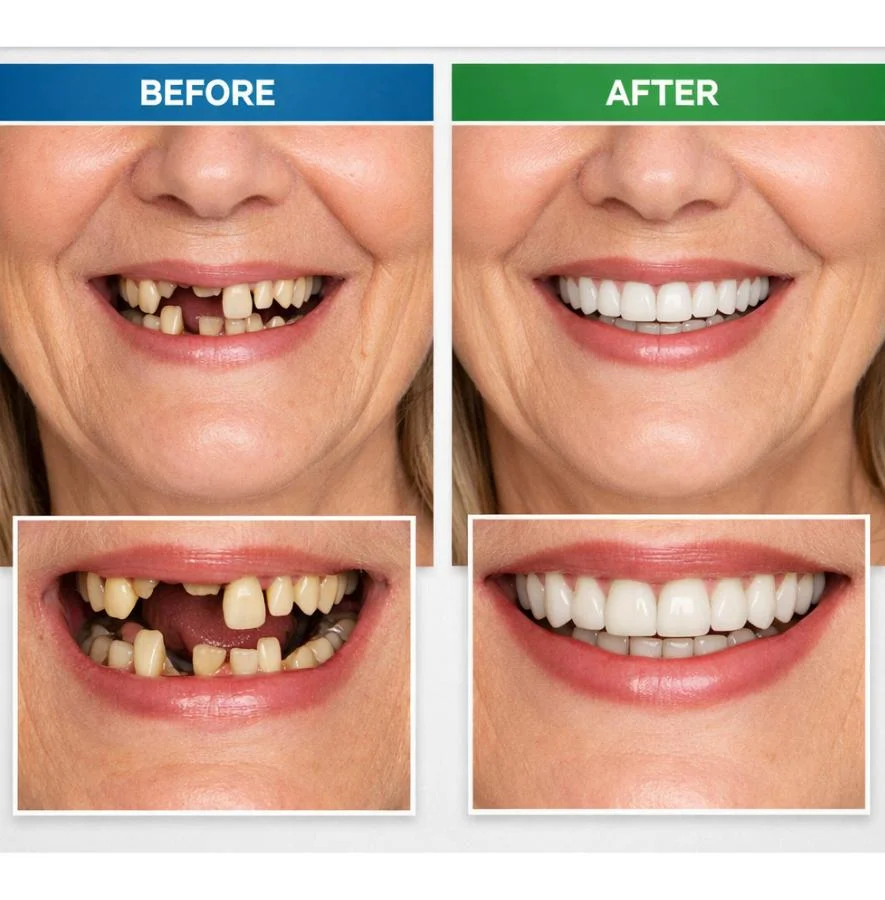
Full Mouth Rehabilitation Before and After: What Changes Can You Expect?
The results of full mouth rehabilitation depend on the condition of your teeth before treatment and the procedures used.
Here are some common improvements patients may experience.
| Before Treatment | After Treatment |
|---|---|
| Multiple missing teeth | Missing teeth replaced with suitable restorations |
| Broken or damaged teeth | Restored tooth shape and structure |
| Difficulty chewing | Improved chewing comfort |
| Uneven or worn teeth | Improved bite and tooth contacts |
| Poor smile appearance | More balanced and natural-looking smile |
| Old or damaged crowns | New, properly fitted restorations |
Please remember: Before-and-after results vary from patient to patient. Final outcomes depend on bone support, gum health, treatment selection, healing and maintenance.
A dentist should discuss realistic expectations before starting treatment.
How Much Does Full Mouth Rehabilitation Cost in Bhiwadi?
The cost of full mouth rehabilitation in Bhiwadi depends on the number of teeth involved, the treatment procedures required and the materials selected.
There is no fixed price for every patient because one person may need a few crowns, while another may require multiple implants, root canal treatments and gum procedures.
Estimated Full Mouth Rehabilitation Treatment Costs
The following figures are indicative estimates for treatment planning, not confirmed clinic prices.
| Dental Treatment | Approximate Cost in India |
|---|---|
| Dental consultation | ₹300–₹1,000 |
| OPG X-ray | ₹500–₹1,500 |
| Root canal treatment | ₹3,000–₹8,000 per tooth |
| Dental crown | ₹4,000–₹15,000 per tooth |
| Dental bridge | ₹8,000–₹25,000+ |
| Dental implant | ₹20,000–₹45,000+ per implant |
| Complete dentures | ₹8,000–₹25,000 per jaw |
| Bone grafting | ₹5,000–₹25,000+ |
Actual prices vary by clinic, implant system, material, complexity and additional procedures.
Factors That Affect the Total Treatment Cost
Number of teeth involved: Treating a few damaged teeth generally costs less than reconstructing both jaws.
Dental implant requirements: The number and type of implants influence the overall cost.
Crown material: Zirconia, ceramic and metal-ceramic crowns have different prices.
Bone condition: Patients with insufficient jawbone may need bone grafting or other additional procedures.
Existing infections: Gum treatment, extractions and root canal procedures can increase the overall treatment cost.
Is Full Mouth Rehabilitation Worth the Cost?
For patients with multiple dental problems, full mouth rehabilitation can be a long-term investment in oral health.
However, the most expensive option is not always the best option. Treatment should be selected according to clinical requirements, durability, comfort and your budget.
At V Care Dental and Implant Centre, patients can discuss their dental concerns and understand the treatment options before making a decision.
How Long Does Full Mouth Rehabilitation Take?
The treatment duration depends on the procedures involved and the patient’s healing response.
Some patients may complete their restorative treatment within a few weeks, while complex cases involving dental implants may take several months.
| Treatment Type | Approximate Duration |
|---|---|
| Dental crowns and bridges | 1–3 weeks |
| Multiple root canal treatments | 1–4 weeks or longer |
| Dentures | 2–6 weeks |
| Dental implant treatment | 3–6 months or longer |
| Implant treatment with bone grafting | 4–9 months or longer |
| Comprehensive full mouth rehabilitation | 1–9 months or more |
These are general estimates. The actual timeline depends on the number of procedures, healing, laboratory work and clinical complexity.
For example, if you need dental implants in both jaws, the dentist may need to allow time for the implants to integrate with the jawbone before placing the final teeth.
Advantages and Disadvantages of Full Mouth Rehabilitation
Like other major dental treatments, full mouth rehabilitation has benefits as well as limitations.
Advantages
- Restores damaged and missing teeth.
- Improves chewing and biting function.
- Helps improve smile appearance.
- Can address multiple dental problems together.
- May improve comfort while speaking and eating.
- Offers different treatment choices based on the patient’s needs.
Disadvantages and Limitations
- Treatment can involve multiple appointments.
- The overall cost may be high.
- Some procedures require healing time.
- Dental implants involve surgery.
- Certain restorations may need replacement in the future.
- Existing gum disease or poor bone support can complicate treatment.
- The outcome depends on proper oral hygiene and regular dental check-ups.
A good treatment plan should always balance the patient’s expectations with what is clinically achievable.
Full Mouth Rehabilitation vs Full Mouth Dental Implants
Many patients confuse full mouth rehabilitation with full mouth dental implants. Although these treatments can overlap, they are not the same.
| Full Mouth Rehabilitation | Full Mouth Dental Implants |
|---|---|
| Comprehensive restoration of oral health | Replacement of missing teeth using implants |
| May include natural teeth | Mainly used when several or all teeth are missing |
| Can involve crowns, bridges and dentures | Uses implant-supported crowns or bridges |
| Focuses on teeth, gums and bite | Focuses on replacing missing teeth |
| May not require surgery | Usually involves implant surgery |
If you still have healthy natural teeth, preserving them may be a better option than removing them unnecessarily.
Full mouth dental implants are generally considered when most or all teeth are missing or cannot be saved.
Who Is a Suitable Candidate for Full Mouth Reconstruction?
Adults with multiple damaged or missing teeth may be suitable candidates.
However, the dentist needs to check certain factors before recommending treatment.
- Overall gum health.
- Jawbone density and volume.
- Existing dental infections.
- General health and healing capacity.
- Smoking or tobacco habits.
- Teeth grinding and bite pressure.
- Ability to maintain good oral hygiene.
Patients with uncontrolled gum disease or certain medical conditions may need additional evaluation and treatment before proceeding.
How to Maintain Your Teeth After Full Mouth Rehabilitation
Completing your treatment is only one part of maintaining good dental health. Proper care is necessary to protect your natural teeth, implants and restorations.
Follow these practical tips:
- Brush twice daily using a soft-bristled toothbrush.
- Clean between your teeth using floss or interdental brushes.
- Avoid chewing very hard objects such as ice or hard nuts.
- Do not use your teeth to open packets or bottles.
- Visit your dentist regularly for check-ups.
- Get professional cleaning as recommended.
- If you grind your teeth, ask your dentist whether a night guard is suitable.
- Avoid tobacco and limit habits that can damage your oral health.
If you have implants, bridges or dentures, follow the cleaning instructions given by your dentist.
Why Choose V Care Dental and Implant Centre for Full Mouth Rehabilitation in Bhiwadi?
Choosing the right dental clinic in Bhiwadi is an important decision, especially when several treatments are involved.
At V Care Dental and Implant Centre, the focus is on understanding the patient’s dental condition and recommending suitable treatment options.
When planning full mouth rehabilitation, patients should receive clear information about the procedures, expected results, treatment duration and costs.
Here are some things to look for when selecting a dental clinic:
- Detailed dental examination and diagnosis.
- Proper assessment of teeth, gums and jawbone.
- Treatment planning based on individual requirements.
- Clear explanation of available restorative options.
- Appropriate use of dental X-rays and scans.
- Proper sterilisation and infection-control practices.
- Guidance on post-treatment care and follow-up visits.
Our aim is to help patients make informed decisions about their oral health and achieve a comfortable, functional smile.
Areas We Cover Around Bhiwadi
Patients looking for full mouth rehabilitation and advanced dental treatment can explore consultation options at V Care Dental and Implant Centre.
Our local service focus includes Bhiwadi and nearby residential and industrial areas, such as:
- UIT Sector, Bhiwadi
- Alwar Bypass Road
- Tapukara
- Chopanki
- Dharuhera
- Tijara
- Khushkhera
- Shahjahanpur
- Neemrana
- Manesar
If you are travelling from a nearby area, contact the clinic to confirm the location, appointment availability and treatment consultation details.
Frequently Asked Questions About Full Mouth Rehabilitation in Bhiwadi
1. What is the difference between full mouth rehabilitation and full mouth reconstruction?
Both terms are commonly used for comprehensive dental treatment involving multiple teeth. The aim is to restore oral health, chewing function, bite balance and smile appearance using suitable dental procedures.
2. Is full mouth rehabilitation painful?
Most dental procedures are performed under local anaesthesia to minimise discomfort. You may experience some soreness or swelling after certain treatments, especially dental implant surgery. Your dentist will provide appropriate aftercare instructions.
3. How much does full mouth rehabilitation cost in Bhiwadi?
The cost depends on the number of teeth involved and the procedures required. A treatment plan involving crowns and bridges will have a different cost from one involving multiple dental implants. A dental examination is needed for an accurate estimate.
4. Can I get full mouth rehabilitation if I have several missing teeth?
Yes. Patients with multiple missing teeth may be suitable candidates. Depending on the jawbone condition and remaining teeth, treatment may involve dental implants, fixed bridges or removable dentures.
5. How many days are required for full mouth rehabilitation?
The duration depends on your treatment plan. Some restorative procedures can be completed within a few weeks, whereas implant-based rehabilitation may take several months.
6. Are dental implants necessary for full mouth rehabilitation?
No. Dental implants are not compulsory for every patient. Crowns, bridges and dentures may also be used depending on the condition of your teeth and jawbone.
7. Can old and damaged teeth be saved during full mouth rehabilitation?
In many cases, damaged teeth can be preserved through root canal treatment, crowns or other restorative procedures. However, teeth with severe structural damage or advanced infection may not be suitable for preservation.
8. Is full mouth rehabilitation suitable for senior citizens?
Age alone does not determine whether someone can undergo treatment. Gum health, bone condition, general health and healing capacity are more important factors. A dental examination helps determine suitability.
9. Will my smile look natural after full mouth rehabilitation?
The treatment can improve the appearance of your smile. The dentist considers tooth shape, size, colour, facial features and bite while planning restorations. The final appearance depends on the selected treatment and individual clinical condition.
10. How long do dental crowns and implants last after rehabilitation?
Dental crowns may last around 5–15 years or longer, while dental implants can last many years with proper care. Their lifespan depends on oral hygiene, bite forces, gum health, material quality and regular dental visits. No restoration has a guaranteed lifetime.
11. Can I eat normally after full mouth rehabilitation?
Most patients can gradually return to a normal diet after completing treatment and healing. Your dentist may recommend soft foods initially, especially after implant surgery or other surgical procedures.
12. What tests are required before full mouth rehabilitation?
The dentist may recommend a clinical examination, OPG X-ray, intraoral X-rays, CBCT scan or digital impressions depending on the treatment requirements.
Restore Your Smile with Full Mouth Rehabilitation in Bhiwadi
Living with multiple missing, broken or damaged teeth can make everyday activities like eating, speaking and smiling uncomfortable. Ignoring these problems may also affect your remaining teeth and gums.
Full mouth rehabilitation provides a comprehensive approach to restoring your dental health. With the right combination of dental implants, crowns, bridges, root canal treatment and other restorative procedures, it may be possible to improve both the function and appearance of your smile.
At V Care Dental Clinic & Implant Centre, we encourage patients to get their dental concerns evaluated and understand the available treatment options before proceeding.
If you are searching for an experienced dental team for full mouth rehabilitation in Bhiwadi, book a consultation to discuss your dental condition and get a treatment plan based on your needs.
Your journey towards healthier teeth and a confident smile starts with the right dental consultation.