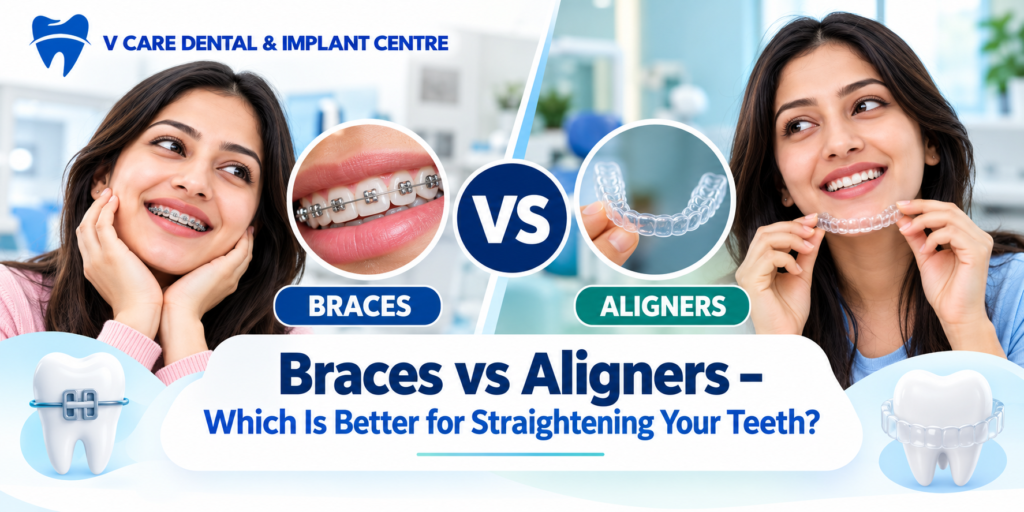
If your teeth are crowded, overlapping, spaced out, or slightly crooked, you may be considering orthodontic treatment. Two of the most common options today are traditional braces and clear aligners.
But which one should you choose?
The answer is not the same for everyone. Braces and aligners work in different ways, and the right treatment depends on your teeth, bite, age, treatment goals, lifestyle, and how consistently you can follow your dentist’s instructions.
For example, someone with mild crowding may be comfortable with clear aligners, while another person with a more complex bite problem may benefit from fixed braces. The best way to decide is to have your teeth and bite examined by an orthodontic professional rather than choosing an option only because it looks better.
At V Care Dental and Implant Centre, patients from Bhiwadi and nearby areas such as Dharuhera, Tapukara, Tauru, Tijara, and Khushkhera can discuss both options and understand which treatment may be suitable for their individual dental condition.
What Are Braces?
Braces are fixed orthodontic appliances used to gradually move teeth into better positions. Traditional braces generally consist of brackets attached to the teeth and an archwire that applies controlled pressure.
The wire is adjusted periodically so that the teeth slowly move over time.
Modern braces are available in different forms, including:
- Metal braces
- Ceramic or tooth-coloured braces
- Self-ligating braces
- Other specialised orthodontic appliances depending on the case
Braces remain attached to the teeth throughout active treatment. This means you do not have to remember to put them back after eating or brushing.
They can be used for many orthodontic problems, including crowded teeth, gaps, rotated teeth, and certain bite problems.

What Are Clear Aligners?
Clear aligners are removable, transparent trays designed to gradually move the teeth.
Instead of brackets and wires, you wear a series of customised aligners. Each aligner is designed to make small changes in tooth position. After a certain period, you move to the next aligner in the series according to your dentist’s treatment plan.
Because the trays are transparent and removable, many adults and teenagers prefer aligners for cosmetic and lifestyle reasons.
However, clear aligners are not simply a “clear version of braces”. They require discipline. The trays generally need to be worn for most of the day and removed mainly for eating, drinking anything other than water, and oral hygiene, according to the treating dentist’s instructions.
Braces vs Aligners: Quick Comparison
|
Feature |
Braces |
Clear Aligners |
|
Appearance |
Visible |
Less noticeable |
|
Removable |
No |
Yes |
|
Eating restrictions |
Some |
Fewer, as trays are removed while eating |
|
Cleaning teeth |
Requires extra care |
Usually easier |
|
Patient compliance |
Less dependent on wearing time |
Highly dependent on regular wear |
|
Mild to moderate crowding |
Often suitable |
Often suitable |
|
Complex orthodontic cases |
Can be very useful |
Depends on the case |
|
Regular adjustments |
Required |
Regular follow-ups are required |
|
Comfort |
May cause cheek or lip irritation initially |
May cause temporary pressure or irritation |
|
Lifestyle convenience |
Moderate |
Generally high |
|
Cost |
Varies by type and case |
Varies by system and case |
The comparison is useful, but it should not be treated as a rule that one treatment is always better. Your dental condition matters more than the appliance itself.
Braces vs Aligners – Which Is Better?
There is no single answer to this question.
Braces may be a suitable choice when significant tooth movement or complex bite correction is required. Clear aligners may be suitable for selected cases where the planned movements can be predictably achieved with removable trays.
The decision usually depends on factors such as:
- Severity of crowding
- Tooth rotations
- Gaps between teeth
- Bite problems
- Jaw relationship
- Tooth position
- Gum and bone health
- Age
- Previous orthodontic treatment
- Patient’s ability to follow instructions
- Budget and treatment expectations
A proper orthodontic examination can help determine which approach is appropriate.
When Braces May Be a Better Option
Braces can be particularly useful when the teeth require more controlled movement or when the orthodontic problem is relatively complex.
They may be considered for:
Severe Crowding
When there is significant lack of space, fixed braces may provide the control required to gradually align the teeth.
Complex Bite Problems
Certain bite problems involving the relationship between upper and lower teeth may require orthodontic mechanics that are more easily managed with fixed appliances.
Rotated or Difficult-to-Move Teeth
Some teeth can be more challenging to move than others. Depending on the case, braces may offer greater control over particular movements.
Patients Who May Struggle With Compliance
One advantage of fixed braces is that they stay in place. You cannot accidentally leave them at home or forget to wear them.
That does not mean braces require no responsibility. Good brushing, dietary care, and regular appointments are still essential.
When Clear Aligners May Be a Better Option
Clear aligners can be a practical choice for many people who want a less noticeable orthodontic treatment.
They may be considered for selected cases involving:
- Mild to moderate crowding
- Small gaps between teeth
- Certain tooth alignment problems
- Some bite corrections
- Relapse after previous orthodontic treatment
The exact suitability depends on the individual case.
Adults Often Prefer Aligners for Lifestyle Reasons
For working professionals, business owners, teachers, and people who regularly meet clients, the appearance of orthodontic appliances can be an important consideration.
Clear aligners are much less noticeable than traditional metal braces. They can also be removed for important occasions when advised by the treating dentist, although they should not be removed unnecessarily because consistent wear is a major part of successful aligner treatment.
For an adult living in Bhiwadi and working in nearby areas such as Dharuhera or Gurugram, this flexibility can make aligners an attractive option.
Pros and Cons of Braces
Advantages of Braces
- Suitable for Many Types of Cases
Braces can be used to address a wide range of alignment and bite problems.
- No Daily Decision About Wearing Them
Once fixed, braces remain on the teeth throughout treatment.
- Good Control of Tooth Movement
The orthodontist can make adjustments during follow-up visits to guide the teeth.
- Different Types Are Available
Patients who are concerned about appearance can ask about ceramic or tooth-coloured options where clinically appropriate.
Disadvantages of Braces
- More Visible
Traditional metal braces are clearly noticeable.
- Food Can Get Trapped
Food particles can collect around brackets and wires, making brushing and interdental cleaning particularly important.
- Initial Discomfort
Some patients experience pressure or mild soreness after braces are fitted or adjusted.
- Certain Foods May Need to Be Avoided
Hard, sticky, or chewy foods can damage brackets or wires.
Pros and Cons of Clear Aligners
Advantages of Aligners
- Less Noticeable
Clear aligners are designed to be discreet, which is one of their biggest attractions.
- Removable
You can generally remove them while eating and brushing, as instructed by your dentist.
- Easier Oral Hygiene
Because the trays are removable, brushing and flossing can usually be performed without working around brackets and wires.
- Fewer Food Restrictions
Since aligners are removed before eating, you generally do not have the same type of food restrictions associated with fixed braces.
Disadvantages of Aligners
- They Require Discipline
This is perhaps the biggest point patients should understand.
If you frequently remove your aligners or do not wear them for the recommended duration, treatment may not progress as planned.
- Not Every Case Is Suitable
Some complex orthodontic movements may require braces or additional orthodontic techniques.
- Trays Can Be Lost
Because aligners are removable, they can be misplaced. This can be particularly common among younger patients.
- You Need to Maintain the Trays
Aligners should be cleaned properly and handled according to your dentist’s instructions.
Braces vs Aligners: Treatment Duration
Patients often ask, “How many months will braces or aligners take?”
There is no fixed treatment duration that applies to everyone.
Depending on the complexity of the case, orthodontic treatment may take several months to around two years or sometimes longer.
Mild alignment problems may require less time, while significant crowding or bite correction can take considerably longer.
Treatment duration depends on:
- Complexity of the case
- Amount of tooth movement required
- Patient’s age and dental condition
- Type of orthodontic treatment
- Patient compliance
- Missed appointments
- Breakages or lost appliances
- Biological response to tooth movement
A dentist or orthodontist can give you a more realistic estimate after examining your teeth.
Which Is Faster: Braces or Aligners?
It is not accurate to say that aligners are always faster than braces or that braces always provide faster results.
In some straightforward cases, aligner treatment can be relatively quick. In other cases, braces may be more appropriate and efficient for the required tooth movements.
The focus should be on achieving a stable and healthy result rather than choosing treatment only because someone promises a shorter timeline.
Braces vs Aligners Cost in India
The cost of orthodontic treatment varies considerably across India.
For both braces and aligners, the final cost can depend on:
- Type of braces or aligner system
- Complexity of the case
- Treatment duration
- Number of aligners required
- Additional orthodontic procedures
- Follow-up appointments
- Retainers after treatment
- Experience and expertise of the treating dental professional
- Location of the dental clinic
Approximate Cost Range
As a broad Indian reference, orthodontic treatment can range from around ₹25,000 to ₹1,50,000 or more, depending on the treatment type and individual case.
Traditional metal braces are generally less expensive than premium clear aligner systems, although prices vary from clinic to clinic and from one case to another.
Patients should ask for a complete treatment estimate rather than comparing only the initial price.
A proper consultation should clarify what is included, such as scans, appointments, refinements, retainers, and follow-up care.
Before and After Braces or Aligners
The purpose of orthodontic treatment is not simply to make the front teeth look straight.
A good treatment plan considers:
- Tooth alignment
- Bite relationship
- Function
- Facial balance
- Gum health
- Long-term stability
- Overall oral health
Before starting treatment, your dentist may assess your teeth, bite, photographs, X-rays, scans, or dental models depending on your case.
After treatment, the teeth are expected to appear more aligned, but the final result depends on the original condition and the treatment plan.
Why Retainers Are Important After Treatment
One common mistake is assuming that orthodontic treatment ends when the braces come off or the final aligner is completed.
Teeth can shift over time.
That is why retainers are commonly recommended after active orthodontic treatment. They help maintain the new tooth positions.
Your dentist will explain the type of retainer and how long it should be worn.
Which Is More Comfortable: Braces or Aligners?
Both options can cause some temporary discomfort.
With braces, patients may experience pressure or mild soreness after placement or adjustments. Brackets can also cause temporary irritation of the cheeks or lips.
With aligners, patients may feel pressure when moving to a new tray. The edges of the trays can occasionally cause irritation.
Usually, patients gradually become accustomed to the appliance.
If you experience severe pain, a broken bracket, a sharp wire, or a damaged aligner, contact your dental clinic rather than trying to manage the problem yourself.
Braces or Aligners for Teenagers
Teenagers can be suitable candidates for either braces or aligners, depending on their dental development and orthodontic problem.
The biggest practical difference is compliance.
A teenager using aligners needs to remember to wear them consistently and keep them safe when removed.
For a teenager who frequently loses things or forgets instructions, fixed braces may sometimes be easier from a compliance perspective.
Parents should discuss the treatment options with the orthodontist and consider the child’s dental condition, habits, responsibility level, and expectations.
Braces or Aligners for Adults
Adults often have different priorities.
Many working adults want orthodontic treatment without making braces a prominent part of their appearance. For selected cases, clear aligners can provide this option.
However, age alone does not determine whether aligners are suitable.
An adult with significant crowding or a complex bite problem may still require braces or another orthodontic approach.
A consultation is therefore more useful than choosing an appliance based only on appearance.
Can Aligners Fix All Teeth Problems?
No.
Clear aligners are highly useful for many orthodontic cases, but they are not suitable for every patient or every type of tooth movement.
Your dentist or orthodontist needs to evaluate:
- Crowding
- Spacing
- Tooth rotation
- Bite
- Jaw relationship
- Existing dental restorations
- Gum condition
- Bone support
- Overall oral health
If your teeth have cavities, active gum disease, or other dental problems, these may need attention before orthodontic treatment begins.
What Should You Check Before Starting Orthodontic Treatment?
Before choosing braces or aligners, ask your dentist these questions:
- What exactly is my orthodontic problem?
Ask whether the issue is crowding, spacing, bite-related, tooth position, or a combination.
- Which treatment options are suitable for my case?
Do not assume that the most popular option is automatically suitable for you.
- How long is the expected treatment?
Ask for a realistic estimate rather than a guaranteed timeline.
- What will the total cost include?
Confirm whether scans, consultations, refinements, retainers, and follow-up visits are included.
- What happens after treatment?
Ask about retainers and long-term maintenance.
- What happens if treatment does not progress as planned?
Understanding the follow-up and refinement process before starting can prevent confusion later.
Practical Tips for Successful Orthodontic Treatment
Whether you choose braces or aligners, your habits can make a major difference.
Maintain good oral hygiene: Brush carefully and clean between your teeth regularly.
Attend scheduled appointments: Orthodontic treatment requires monitoring.
Follow dietary instructions: Especially when wearing fixed braces.
Wear aligners as instructed: Removing them too frequently can interfere with treatment progress.
Do not ignore discomfort or damage: Contact your dental clinic if something breaks or does not fit properly.
Complete the retainer phase: Retention is part of orthodontic treatment, not an optional extra.
Braces vs Aligners: What Should You Choose?
Instead of asking, “Which one is better for everyone?”, a more useful question is:
“Which option is suitable for my teeth and lifestyle?”
If appearance and removability are major priorities and your case is suitable, clear aligners may be worth discussing.
If your orthodontic problem requires more controlled tooth movement or you prefer a fixed appliance, braces may be considered.
In some cases, the decision is straightforward. In others, your dentist may discuss more than one treatment approach and explain the advantages, limitations, expected duration, and cost of each.
The final decision should be based on a proper clinical assessment rather than advertisements, social media trends, or a friend’s experience.
Braces and Aligners in Bhiwadi
If you are looking for braces or clear aligners in Bhiwadi, you can discuss your orthodontic concerns with the dental team at V Care Dental and Implant Centre.
Patients also visit dental clinics in Bhiwadi from nearby areas including Dharuhera, Tapukara, Tauru, Tijara, and Khushkhera.
Whether you are concerned about crowded front teeth, gaps, crooked teeth, or your bite, an orthodontic consultation can help you understand what is causing the problem and which treatment options may be appropriate.
For adults, teenagers, and families, discussing your expectations, budget, treatment duration, and daily routine with the dentist can make the decision much easier.
Final Thoughts
Choosing between braces and clear aligners is not simply a choice between metal and transparent trays. The right treatment should address your actual orthodontic problem while fitting your lifestyle, expectations, budget, and ability to follow the treatment plan.
Braces can provide reliable control for a wide range of orthodontic problems, while clear aligners offer a discreet and removable option for many suitable cases. Neither should be selected solely on appearance or price.
If you are considering orthodontic treatment in Bhiwadi, a personalised consultation can help you understand your options before making a decision.
V Care Dental Clinic & Implant Centre provides dental and orthodontic care for patients from Bhiwadi and nearby areas. Discuss your teeth alignment concerns with a dental professional and understand the treatment approach that may be suitable for your smile.